EPITAQSi
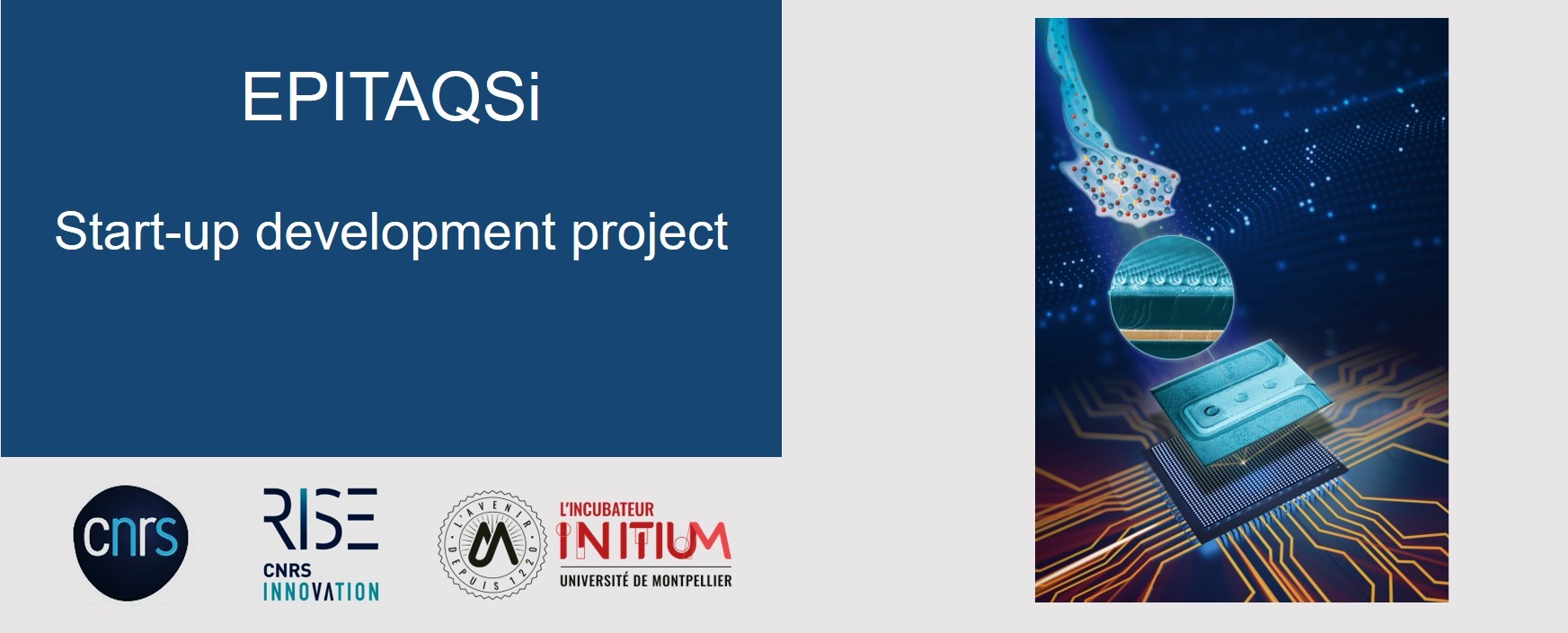
EpitaqSi is developing innovative solutions for integrating multifunctional oxides into silicon technology and its micromachining. The aim is to develop cost-effective devices that will offer superior performance to current systems. The project is based on a new liquid-phase chemical deposition technology that is better suited to the microelectronics format, making it possible to develop epitaxial oxides on large surfaces (up to 6-inch silicon wafers) using additive growth on sub-micron scales.
EPiTAQSi
Financial Suport: CNRS
Project Leaders: Dr. Adrien Carretero-Genevrier, David Sanchez-Fuentes, Ricardo Garcia
Title: Epitaxy of multifunctional oxides on silicon for innovative devices nanoelectronics advanced
Dates: 01/01/2023 – To date
Thanks to the research projects carried out by the NanoChemLab team in recent years, we have decided to develop an innovative idea that we want to turn into a business. The aim is to add value to our results by identifying potential markets, creating a business model and solid marketing in order to develop a start-up. Recently, NanoChemLab was awarded the prestigious RISE2023 and Horizon Booster programmes as well as the ERCPoC2022 to create a start-up using our technology. EPITAQSi's ambition is to market and implement products incorporating components such as sensors in a wide range of application areas, using low-cost, industrialisable and environmentally-friendly methods. Our technology is based on oxides with complex compositions/architectures, obtained thanks to the advantages of the deposition technology used.
In January 2024, our start-up team won the INITIUM incubation programme at the University of Montpellier and we signed a temporary public domain occupation agreement with the University of Montpellier to establish our start-up at the IES in 2025. The NanoChemLab team have recently been awarded the CNRS PREMAT2024 pre-maturation project, and the Montpellier Innovation Booster (BIM_2024), to develop and commercialise (i) the largest existing positioning detector (PSD) for optical tracking and displacement detection applications and (ii) an ultrasensitive piezoelectric biosensor for the detection of pathogens in liquids.
FACKIRSLIDE
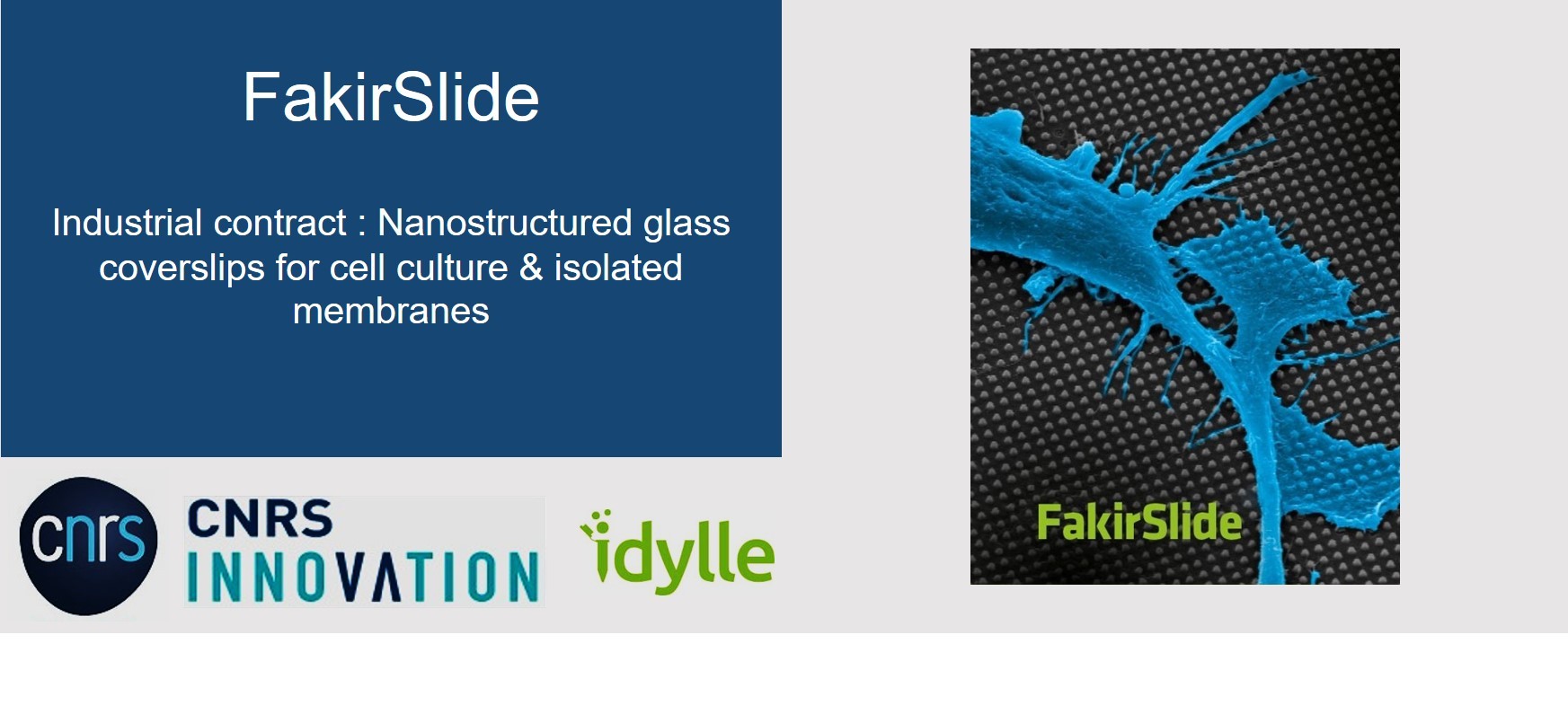
Fackirslide is developing innovative processes for manufacturing nanostructured silica thin films on glass slides. These substrates have proved extremely useful in biological studies due to their ability to induce mechanical stimulation in cells, as well as their compatibility with advanced microscopy techniques. The numerous publications made using these nanostructured substrates have generated interest in the scientific community for their use in biological systems. Due to the advantages of the manufacturing methodology, such as its low cost, high reproducibility and speed of production, the company Idylle ( https://www.idylle-labs.com ) has started to market the product called FakirSlides, which was designed by NanoChemLab team in collaboration with quantitative biology of membrane traffic and pathogenesis team of IRIM lab (more details about our story that led to this invention
PDF).
FACKIRSLIDE
Financial Suport: Industrial contract and technlogical trasfert with Idylle-labs company
Project Leaders: Dr. Adrien Carretero-Genevrier, David Sanchez-Fuentes, Laura Picas
Title: Nanostructured glass coverslip for cell culture and isolated membranes
Dates: 01/01/2023 – To date
This new product is a ready-to-use lamella with micro- and nanostructures of different morphologies and sizes, enabling a variety of well-controlled topological signals to be induced on living cells or isolated membranes. Our research team is currently producing nanostructured substrates for the company Idylle under a service contract with IES and a licence with CNRS INNOVATION resulting from a declaration of invention made in 2023. This product has been on the market for 2 years and is sold worldwide, with customers in the United States, China, Europe and India.